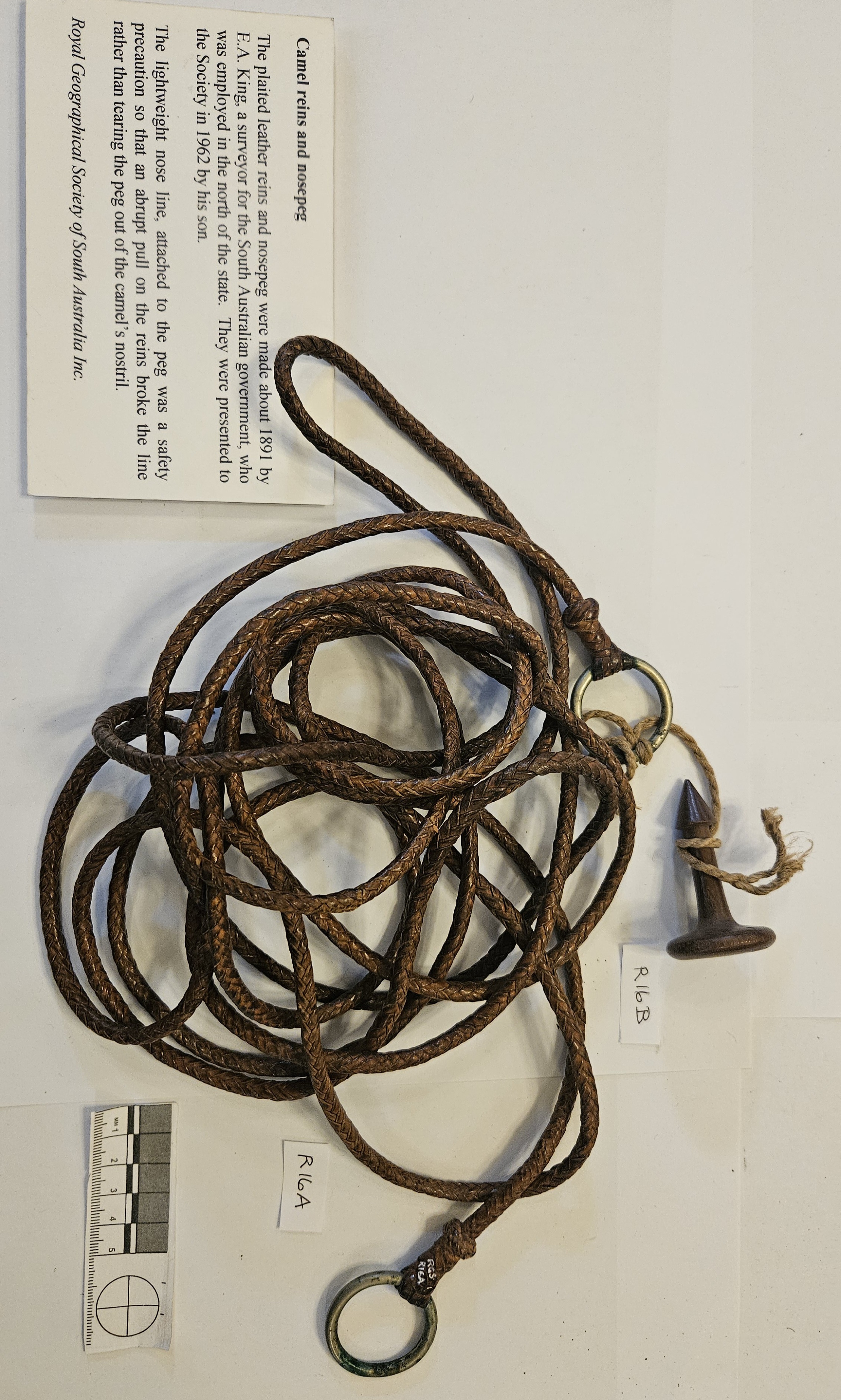
Camel Reins and Nose Peg
The plaited leather reins and nose peg were also made in 1891 by E King. The nose line attached to the peg is a safety precaution so that an abrupt pull on the line breaks the line rather than tearing the camel’s nostril.
SOURCE RGSSA R16B
Camels for riding and transport became an important mode of transport in opening up outback South Australia. They were used in exploration, transport of people and supplies and of course returning with produce such as wool and wheat for export. Camels carried survey equipment and supplies in the latter half of the nineteenth century and were still in use into the 1920s. Afghan Cameleers were employed to manage them and they taught the survey teams to load and care for the camels.
The Government established a camel depot at Mount Serle, near Leigh Creek, in 1896 and this continued well into the twentieth century. It was managed on behalf of the Dept of Lands and Survey and Dept of Mines. The depot had 160 camels. In 1905 it had 75 camels and a number of calves. There was also another camel depot at Muloorina, near Marree. The Afghan cameleers and their families were generally living on the outskirts of outback towns such as Maree, Farina, Oodnadatta. Today the remains of the first mosque in Australia can be seen at Maree. Camels were used as late as 1932 for the Endeavour Expedition led by Lawrence Wells.
Relics & Artefacts |