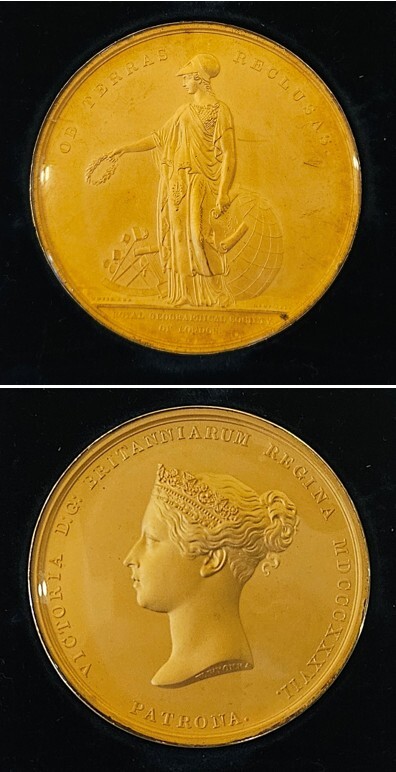
Royal Geographical Society (London) Patron's Medal1840 (Gold)
Presented to Robert H Schomburgk For his perseverance and success in exploring the territory and investigating the resources of British Guyana.
Source RGSSA R69 – donated by Otto Schomburgk (nephew)
Sir Robert Herman Schomburgk (1804 -1864)
Robert Hermann Schomburgk born in Saxony Germany. After training as a botanist, he spent much of his life as an explorer, surveyor, botanist, and diplomat for the British government. In 1834, Schomburgk was commissioned by the Royal Geographical Society London to lead one of its first funded explorations—into the interior of British Guyana in South America. With his brother Moritz Richard (known as Richard) he collected numerous geological, zoological, and botanical specimens, including a giant water lily. Robert named this Victoria regia (Victoria Amazonia) in honour of Britain's monarch.
In 1865 Robert’s Brother Richard Schomburgk (1811-1891) was appointed second director of The Adelaide Botanical Gardens.
Up to 300,000 visitors to the Botanic Garden per year were recorded when the population of the whole colony was about 163,000. An early success was the first flowering of giant water-lily Victoria regia (later Victoria amazonica), which attracted extraordinary attention, with people visiting during their lunch-breaks and hour-by-hour descriptions in the newspapers of the opening of the flowers.
Richard imported from Bremen, a prefabricated tropical Palm House, which opened in 1877. It is now the only one of its kind outside Europe. In 1884 the Museum of Economic Botany, built in classical style, opened to exhibit specimens of economic plants. Unique in Australia, the Museum still retains its original display cases and stencilled ceiling decoration. It displayed plant materials used for cordage, dyes, fibres, timber, resins, oils, beverages, and medicines, including plants used by Aboriginal people. He conducted trials on cereal plants sent from around the world to learn what could be grown under South Australian conditions.12,000 trees were distributed annually to farmers and city dwellers as Richard was a supporter of reforestation.
Relics & Artefacts |