
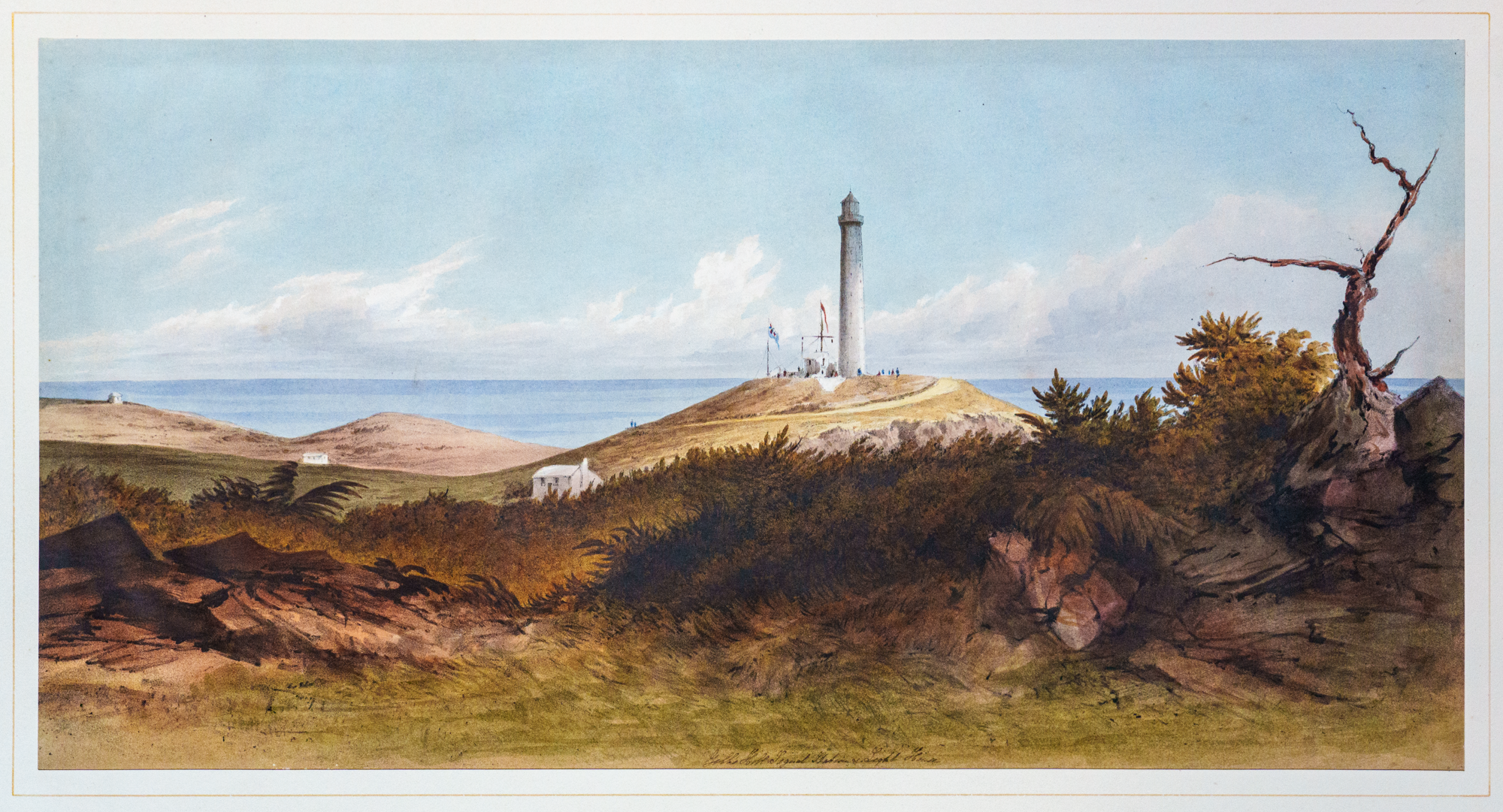
Thirteen views of Bermuda from Edmund Gilling Hallewell's watercolours, lithographed by William Parrott and hand coloured. They are both rare and historically important as the most comprehensive and accurate set of views of Bermuda published in Victorian times.
Edmund Gilling Hallewell’s first Bermuda work was a series of five very long wartercolour panoramas made in 1842 followed by a sixth in 1844. At the time he was in the army with the rank of lieutenant and then adjutant.These panoramas were sent to the Foreign Office to encourage emigration as they comprised a very accurate representation of the geography of Bermuda at the time.
Later Hallewell did some topographic painting with Capt. Michael Seymour RN and this seemed to have prompted him to produce a further set of thirteen watercolour views of Bermuda. They were refered to as “sketches” which was common terminology for such works at the time. Reproduced as hand coloured lithographs by William Parrott and published in London in 1848 these comprise this RGSSA treasure. They can also be joined together in sets of six, four and three as folded panoramas.
RGSSA catalogue rgsp 917.299 H186 d Very large red box Cabinet 2 Shelf 4
Edmund Gilling Hallewell was born in April 1822 in Gloustershire, England. His military career began when he purchased the rank of Ensign in December 1839. He first served in Ireland and was then posted to Bermuda where he arrived in November 1841 with the 20th Regiment of Foot or East Devons. In 1842 he was promoted to lieutenant and in 1844 to adjutant. Hallewell also served as private secretary to Governor Colonel William Reid who was keen on developing agriculture on the island and saw Hallewell's "sketches" as a way of promoting this in London. Hallewell married Reid's daughter, Sofia.
In 1848 Hallewell left Bermuda and was posted to Canada where he purchased the rank of captain. He continued to paint at his various postings including Halifax, Kingston and Montreal. He returned to England in 1850 and exhibited his works at the Royal Academy, the British Institution and the Society of British Artists. In 1854 he was transferred to the North Gloustershire Regiment and served with distinction in the Crimean War from 1854-1855. During that time he produced sketches, watercolours and plans notably of Sebastopol. Promoted to full colonel in 1860 he became Commandant of the Royal Military College, Sandhurst, where he died in office.
The following is taken from the Lusher Gallery web site and gives a useful description of Hallewell's pictures of Bermuda.
The thirteen lithographic Hallewell prints, published in London and Bermuda in 1848 after being re-drawn by W. Parrott from Hallewell’s watercolours, form three extended panoramas: six views form a panorama of the islands in the Great Sound seen from a hill west of Gibbs Hill lighthouse; four form a panorama from a hill on Spanish Point looking to the Great Sound with the shores of Warwick, Southampton, and Sandy’s parishes beyond; and three views from near St. David’s lighthouse form a panorama looking over Smith’s Island to the town and parish of St. George’s. One of the more notable prints presents a view of the Gibbs Hill Signal Station and Lighthouse, the first to offer a representation of the lighthouse in significant detail, also conveying a sense of the tower’s isolation from anything else of particular significance at that time. Of further note is a view (from near Spanish point) of Timlin’s Narrows/Boss Cove/The Rock Passage/One Rock Passage/Oxford/Ship Passage, an image that clearly reveals the archipelagic nature of Bermuda, as well as emphasizing the strong connection of Bermudians to the water - which, at this period, still continued to be the most convenient mode of transportation for much anything beyond a walk to the parish church on Sundays. Additionally, from a vantage point near Gibbs Hill, Hallewell executes a rather expansive view of central Bermuda, from western Pembroke to Devonshire, with Hamilton portrayed as a conspicuous jumble of white buildings enfolded in cedar woodlands.
The 1848 suite was originally issued in relatively small numbers and is now extremely rare: only two copies (one incomplete) are listed as having sold at auction in the past 35 years. Though the work does not appear in the standard bibliographies, it is known to have been issued in two forms: tinted lithographs (an edition of which was sold by Nicholas Lusher of Nicholas Lusher Antiques and Fine Art) and hand-coloured lithographs, cut down and mounted in imitation of watercolours. The suite holds the distinction of comprising the most extensive set of printed views of the island ever published, imparting for posterity an accurate representation of the island as it existed in the early Victorian period.
Reference The Lusher Gallery , New York and Bermuda web site https://lushergallery.com/edmu...
© The Royal Geographical Society of South Australia