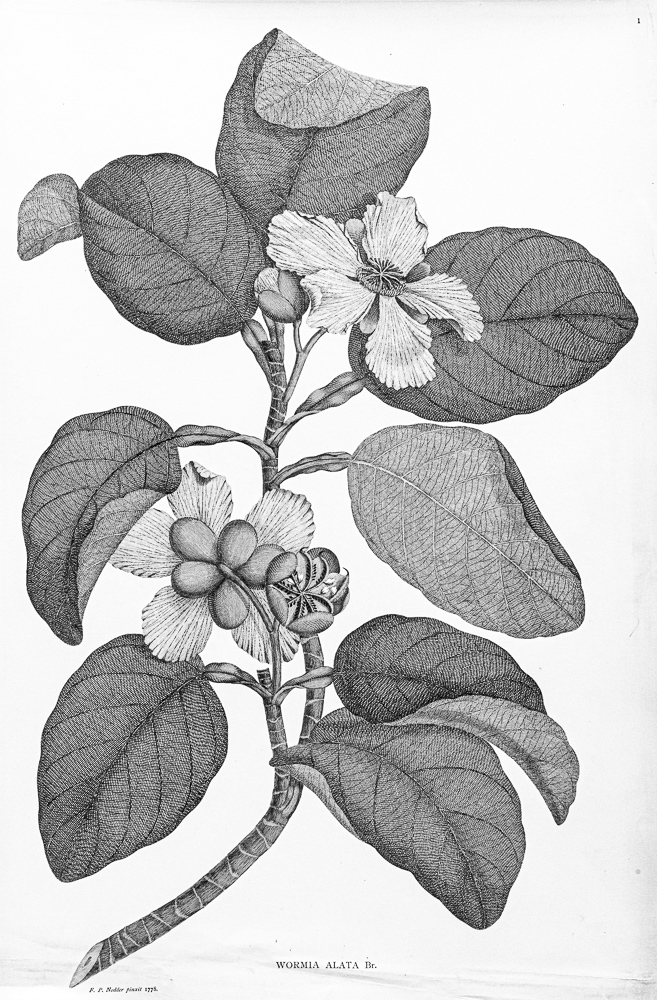
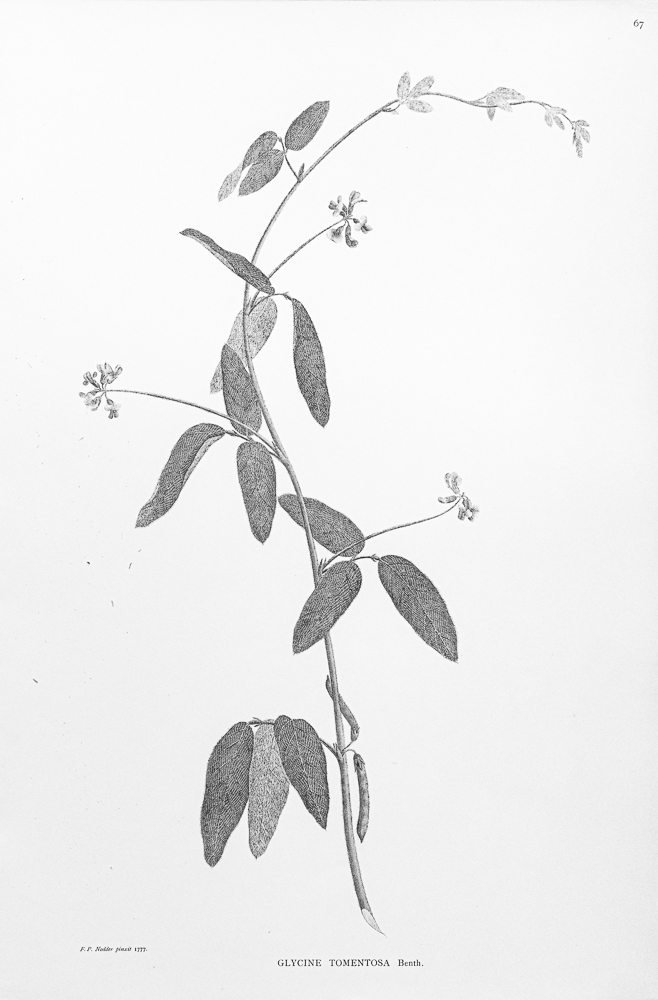
These photolithographic prints of Australian plants were made between 1900 and 1905 from a selection of the engraved copper plates ordered by Joseph Banks on his return with HMS Endeavour in 1771.
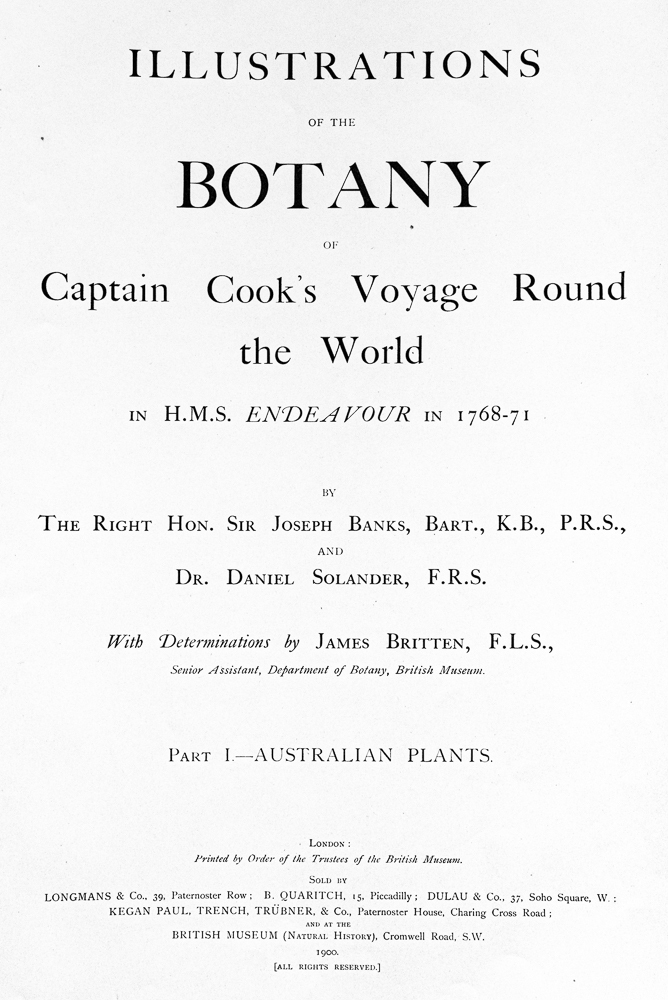
Illustrations of the Botany of Captain Cook’s Voyage Round the World in HMS Endeavour in 1768-71 by the Right Hon. Sir Joseph Banks KB, FRS and Dr Daniel Solander FRS with Determinations by James Britten FLS, London, printed by Order of the Trustees of the British Museum, 1902. Part I (1-100) 1900, Part II (101-242) 1901
It was not until 1980-1990 that Banks’ Florilegium was published in colour using all 743 engraved copper plates. The original watercolours and sketches of the plants were made on the voyage by Sydney Parkinson who died tragically after Endeavour left Batavia on the way home in 1771.
Sir Joseph Banks joined Captain Cook’s HMS Endeavour at Plymouth in 1768 aged 28 and returned to London in 1771 with over 30,000 plant specimens many of which had never been seen before. Banks was immensely wealthy and had a great interest in science and so financed the extensive scientific work carried out on the Endeavour voyage himself. On board were also Daniel Solander (1733-1782), naturalist, who was responsible for identifying and describing the specimens, and Sydney Parkinson (1745-1771), illustrator, who prepared over 900 drawings of the plant specimens during the voyage of which 675 were uncoloured sketches and 280 finished watercolours. Because of the large number of specimens and lack of time, on the back of the sketches Parkinson wrote notes on the colours of the various leaves and flowers so the drawings could be completed later.
Soon after his return to London, in 1773 Banks proposed the publication of an illustrated catalogue of the plants collected on the voyage with Cook to be known as the Bank’s Florilegium. In order to do this he put together a team of five well known artists (John Clevely, John Fredrick Miller and his brother James, Fredrick Polydore Nodder and Thomas Burgis)* who produced finished watercolours of each specimen from Parkinson’s sketches. These were used by 18 engravers retained by Banks to prepare the 743 copper plate engravings to be used in the printing of the catalogue. Daniel Solander continued during this time to catalogue the plants and write the scientific descriptions as letterpress to go with the engravings.
*On the bottom left hand corner of many of the prints appears the artist’s name and date – for example F.P. Nodder pinxit 1778. Pinxit literally meaning he/she painted it.
The preparation of the watercolours, the engraving of the copper plates and the writing of the descriptions was an enormous task and took thirteen years to complete finishing in 1784. While Banks continued to finance this work he became involved with other things such as becoming President of the Royal Society, a post he held for over 40 years. So the printing from the copper plates (engravings) was not carried out during his lifetime and after his death in 1820 the 743 copper plates were bequeathed to the British Museum.
It was not until James Britten (1846-1924), of the British Museum, selected 328 of the copper plates and, using the process of photolithography to make these black and white prints, published this edition of Illustrations of the Botany of Captain Cook’s Voyage Round the World between 1900 and 1905.
This RGSSA Treasure is part of the York Gate Library purchased in 1905 by the then Royal Geographical Society of Australasia (South Australian Branch).
The copper plates were not used again until a very small run was made of 30 uncoloured engravings published in 1974 by Lion and Unicorn Press.
Finally, over ten years between 1980 -1990, 738 of the original copper plates which had been made 200 years previously, were used to make the engravings for 100 full colour sets of Bank’s Florilegium. Publishing was by Alecto Historical Editions and the Natural History Museum, London.
rga 581 994 B218 d (pt.1-2) d Cabinet No.4 shelf 8
These prints have been printed using the process of photolithography as follows.
The original engraved copper plates were first used to print off one copper engraving of high quality in black and white on paper. This engraving was then photographed and the negative used to project the image onto a lithographic stone on which light sensitive solution has been spread. After treatment this was then used to print off the number of copies required .
Reference: Rice, Tony and Bellamy, David, Voyages of Discovery, Allen and Unwin, 2008.
© The Royal Geographical Society of South Australia