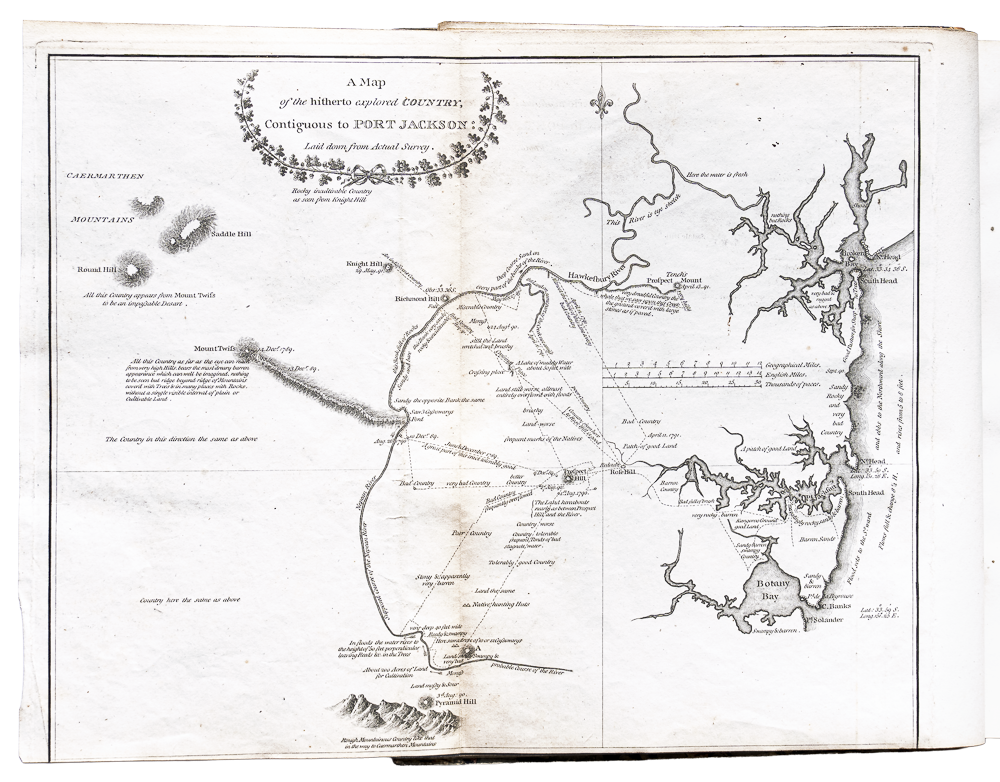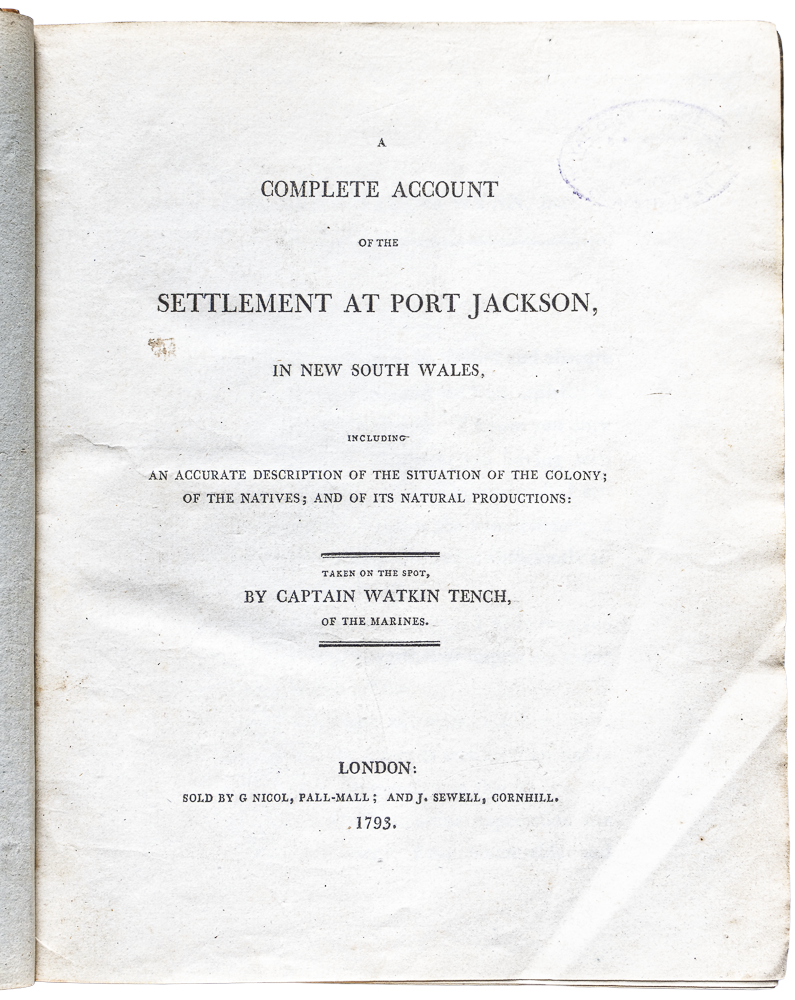
Watkin Tench served in the Royal Marines in the Royal Navy and sailed with the First Fleet to Australia on the transport Charlotte arriving at Port Jackson 24th January 1788. He spent nearly four years in Australia and his two books are noted for their accurate observations of the land and its people and are among the most highly regarded accounts of the early colony.
Watkin Tench (1758-1833) joined the Royal Marines in 1776 as a second lieutenant and served on the Nonsuch in the American War of Independence. He then served on the Mermaid, was captured, and served three months as a prisoner of war in Maryland.
Then in 1786, with the war over, he volunteered for a three year tour to the convict colony to be established at Botany Bay. He sailed with the first fleet as lieutenant-captain in the Royal Marines on the Charlotte and served in the new colony at Port Jackson from the time it was established in 1788 until he returned to England in 1791 on the Gorgon.
Tench took a keen interest in all aspects of life in the new colony and recorded, in these two books, what he saw and experienced in a detailed and entertaining way. He included reference to the land itself, the native people and the plants and animals. Watkin Tench completed his career in the Royal Marines in 1816 with the rank of Major General.
His two books are;
RGSSA Catalogue numbers - for A Narrative rgsp 919.44041 T289 and for A Complete Account rgsp 994.402 T289
The following is an extract from Chapter 1 of A complete account of the settlement at Port Jackson, New South Wales. It shows the enlightened attitude that Tench developed towards the indigenous population:
"With the natives we were very little more acquainted than on our arrival in the country. Our intercourse with them was neither frequent or cordial. They seemed studiously to avoid us, either from fear, jealousy, or hatred. When they met with unarmed stragglers, they sometimes killed, and sometimes wounded them. I confess that, in common with many others, I was inclined to attribute this conduct, to a spirit of malignant levity. But a farther acquaintance with them, founded on several instances of their humanity and generosity, which shall be noticed in their proper places, has entirely reversed my opinion; and led me to conclude, that the unprovoked outrages committed upon them, by unprincipled individuals among us, caused the evils we had experienced. To prevent them from being plundered of their fishing-tackle and weapons of war, a proclamation was issued, forbidding their sale among us; but it was not attended with the good effect which was hoped for from it. "
And another quotation from A complete account p 45 . This shows the relief when a supply ship arrives after months of near starvation, no news and wondering if the colony would survive.
"At length the clouds of misfortune began to separate and on the evening of 3rd June, the joyful cry of “the flags up” resounded in every direction. As we proceeded the object of our hopes soon appeared:- a large ship, with the English colours flying, working in between the heads, which form the harbour. At last we read “London” on her stern - “Pull away my lads! She is from old England! A few strokes and we shall be aboard! Hurrah for a full belly and news from our old friends.” A few minutes completed our wishes, and we found ourselves on board the Lady Juliana transport, with two hundred and fifty of our country women, who crime or misfortune had condemned to exile."

© The Royal Geographical Society of South Australia