The following is an extract from Anson’s “A voyage around the world-“ Chapter 1 and explains the circumstances and reasons for this voyage
"When in the latter end of the summer of the year 1739, it was foreseen that a war with Spain was inevitable, it was the opinion of some considerable persons then trusted with the Administration of affairs, that the most prudent step the nation could take, on the breaking out of war, was attacking that Crown in her different settlements; for by this means (as at that time there was the greatest probability of success) it was supposed that we should cut off the principal resources of the enemy, and should reduce them to the necessity of sincerely desiring a peace, as they would hereby be deprived of the returns of that treasure, by which alone they could be enabled to carry on a war."
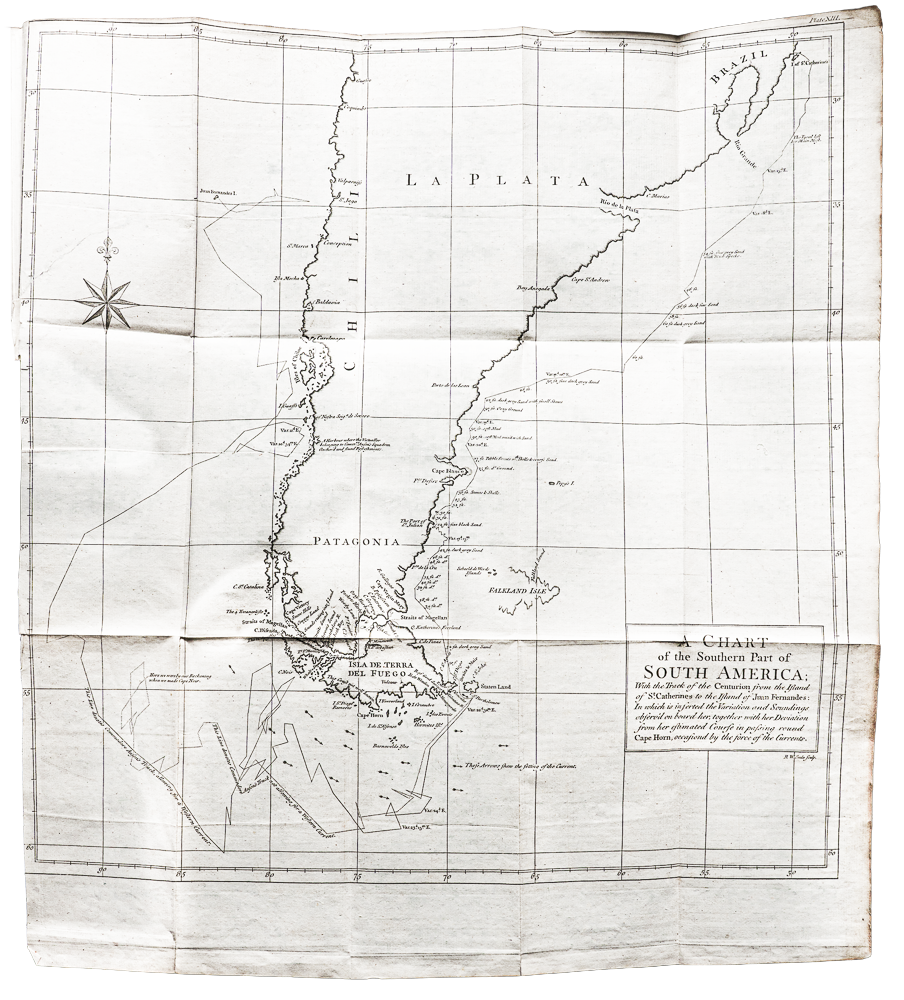
As a result of this policy, in September 1740 a squadron* of Royal Navy ships set sail from St Helens, England. It consisted of five men-of-war, Centurion, Gloucester, Wager, Pearl and Severn, a scouting sloop Trial and two small supply ships Anna and Industry. Their orders were to cross the Atlantic, sail around Tierra del Fuego and Cape Horn “distress the Spanish’ and capture a Spanish galleon laden with treasure.
Commodore George Anson was commander of the squadron and captain of HMS Centurion. Gunner John Bulkeley was on board HMS Wager. Both men were to publish their journals on their return to England. Remarkably both these journals are in the RGSSA library. The squadron sailed across the Atlantic and down the east coast of South America with the crews suffering from typhoid and scurvy and many dying. As they rounded Cape Horn and sailed through Drake’s Passage they struck very heavy weather with high winds and mountainous seas. The depleted ships’ crews made sailing difficult and as well the ships all suffered considerable damage and eventually lost contact with each other.
HMS Wager managed to round Cape Horn but then heading north sailed too close to the west coast of Terra del Fuego. Being badly damaged she was unable to resist the strong westerly current and ran aground on the rocky shore. Centurion also rounded Cape Horn and continued sailing northwards up the west coast of Peru to the rendezvous at the Juan Fernandez Islands where they were joined by Gloucester, Trial and Anna. However, these ships were so badly damaged they were subsequently abandoned with Centurion taking on surviving crew members.
Centurion, still under the command of George Anson, and although damaged, was still seaworthy and sailed across the Pacific reaching Canton, China. Anson was determined to complete his orders including the capture of a Spanish galleon. It was rumored that one was off the north-east coast of Samar Island in the Philippines and so he proceeded to patrol the area and prepare his men for action. On 20 June 1743 they sighted the galleon Our Lady of Covadonga (Nuestra Senora de Covadonga) under the command of Geronomo Montero. A sea battle ensued between the two ships at close quarters and Anson, with greater fire power and having drilled his remaining crew effectively, overcame the Spanish ship and captured the treasure estimated to have been worth $80 million – the largest treasure ever captured by a British naval commander. A year later Anson and his crew paraded through the streets of London with the silver and gold as heroes.
*This naval term was subsequently widely adopted to apply to air force units.